
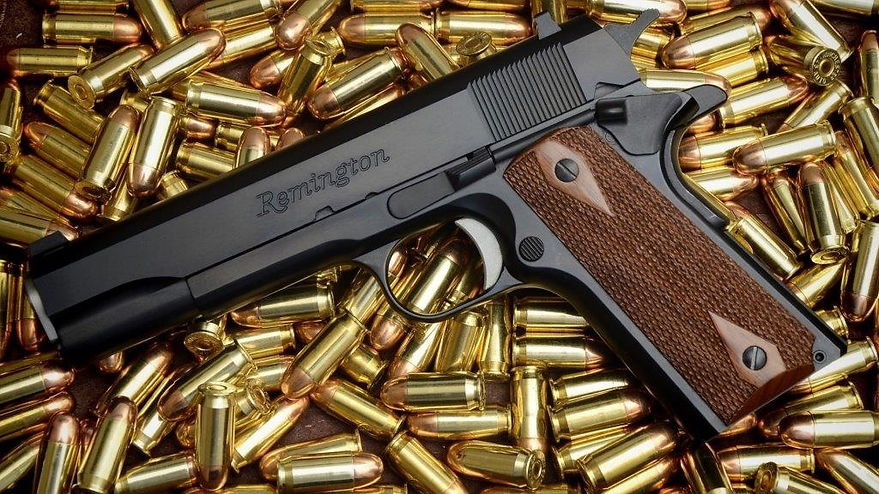
Returning to its handgun-manufacturing roots, Remington’s R1 combines the company’s craftsmanship with a classic version of the venerable 1911, they produced during World War I in small and World War II in large numbers.
In the 1910s, Remington Arms produced a 1911 style pistol modeled after the Colt 1911, receiving a contract from the US government to produce the pistols. The war came to an end only years later and Remington shut down their production of the 1911 in 1919. In April of 2010 Remington announced that they would start producing the 1911 again. This time the pistol would be marketed as the Remington 1911 R1.
As in WWI and WWII this is clearly a Remington 1911 and not a Colt.
The R1 fuses over 100 years of classic elements in to the Remington 1911 that, as always, stands apart from the original Colt and all the other spin off mainstream with it’s own history, individualism and identity.
The Remington has a character and standing of it’s own.
This should go for the owners also – show me you’re your gun and I’ll tell you who you are…
No, it’s not a $1000+ high end gun. The R1 is an affordable classic 1911 work horse that does the job. No more, no less.
Enhanced , Stainless, Carry and 9mm versions of the R1 have been introduced.
This appreciation society will only cater for the classic R1 version though.
The classic Remington R1 digests .45 ACP, is 8.5 inches (21.6cm) long, 5.5 inches (13.97cm) tall and weighs 38 ounces (1077 grams).
In an effort to retain the aesthetics of its World War I predecessor, the R1 contains such G.I.-style components as a narrow-pad thumb safety and serrated spur hammer.
Harking back to the World War II battlefields of Europe and the Pacific, relief cuts behind the trigger guard provide easier access to the R1′s traditional-looking, short, solid-aluminum trigger.
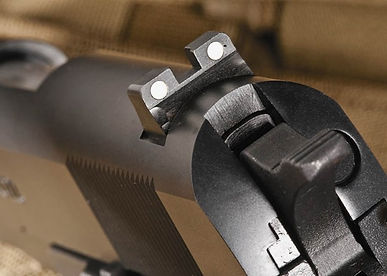
Staying true to its linage and battle-proven reliability, the R1 is a delicate blend of classic features with a hint of contemporary, reliability-based enhancements, such as a flared and lowered ejection port and more prominent sights than the original ones found on G.I. 1911s. The rear sight has two white dots. At the front a single large dot makes getting the gun on target faster than with the traditional sights.
The Remington R1 is accompanied by two seven-round magazines.
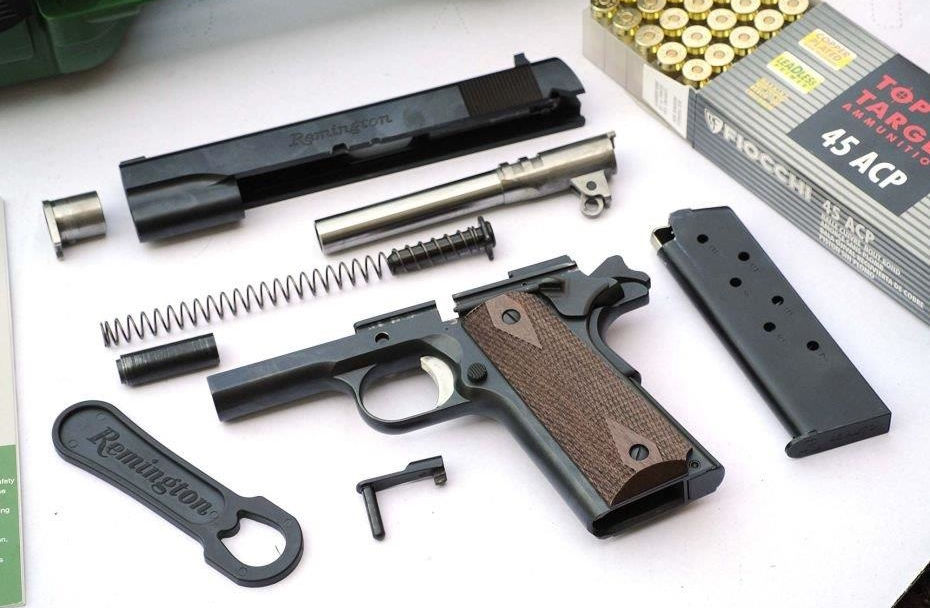
Although identical in disassembly to G.I. 1911s—as seen by the presence of a traditional recoil-spring guide/plug assembly—the R1 contains a match-grade, stainless steel barrel.




History
From http://www.sightm1911.com/lib/history/remingtons.htm
The Remington Government Model Pistols
By Syd
Two Government Model .45 autos carrying the illustrious name of Remington have served our nation’s armed forces. Would it surprise you to know that one of them was built by a typewriter company which had no experience in building firearms? Here’s the story.
In 1873, E. Remington & Sons embarked on a new venture, and in September of 1873, the first Remington typewriters were produced. While it took them 13 years to figure it out, E. Remington realized that they were a firearms builder and not a typewriter company, and in 1886 Remington sold the typewriter business. This business would later become Remington Rand, then Sperry Rand.
Remington-UMC 1911 Pistol
These were difficult times for Remington however, and in March 1888, E. Remington & Sons was acquired by Marcellus Hartley and partners. E. Remington & Sons was reorganized, and the new company was named the Remington Arms Company. In later years, in order to better utilize the potential of the Remington Plant, the company would produce sewing machines and cash registers. (I guess they just couldn’t stay away from the gadgets.) In 1912, The Union Metallic Cartridge Company of Bridgeport and Remington Arms Company were combined into one company and became Remington-UMC, and just in time for World War I.
As the United States was drawn into the war, War Department planners in 1917 estimated that a total of 765,000 pistols would be required. The estimate was later revised upward, first to 1.3 million and then to 2.7 million. There was no way that Colt was going to be able to build that many guns. Orders were placed with Remington-UMC, Winchester, Burroughs Adding Machine Co., Lanston Monotype Machine Co., National Cash Register Co., A.J. Savage Munitions Co., Savage Arms Co., and two Canadian firms, Caron Brothers Mfg. Co., and North American Arms Co., Ltd. Of those firms, only Remington-UMC delivered any meaningful quantity (21,677 of 150,000 ordered). North American did make some pistols, but the total was probably less than 100. Some authorities dispute if North American even completed those.
The Remington-UMC M1911 Pistol
Remington-UMC 1911 Pistol Roll Stamp
The Remington-UMC contract specified a ”target” production rate of 3,000 pistols per day to be reached as soon as possible. The company immediately ran into problems because the necessary production blueprints and specifications were not available. Since interchangeable parts were required, production could not begin until Colt provided drawings. Eventually, a complete set of production drawings and specifications were obtained by Remington-UMC, and the company began to tool up for manufacture of the M1911.
Colt was not being deliberately resistive here. Truth be known, Colt probably didn’t have a complete set of blueprints which would enable another company to quickly tool up and produce pistols. Colt’s manufacturing style in those days relied heavily on the acquired skill and knowledge of the craftsman who worked in their shop, and it is quite likely that many of the “secrets” had never been committed to paper.
The first Remington-UMC pistols were delivered to the government in August 1918, but the company was never able to achieve the desired production rate. The company’s M1911 production contract was cancelled in December 1918, soon after the signing of the Armistice, although production did not actually cease until early 1919. By the end of the war, Remington-UMC had only delivered 13,152 pistols. Total production was only 21,677 pistols when the final deliveries were made in early 1919.
The Remington-UMC M1911s were serially numbered consecutively from 1 through 21,677. The pistols were stamped with inspectors’ initials (either “B” or ”E”). The left sides of the slides were marked with Colt patent dates, the “Remington/UMC” logo arrayed in a circle and “Manufactured by/ Remington Arms UMC Co. Inc./ Bridgeport, Conn., U.S.A.” The left sides of the receivers bore the same “United States Property” markings found on the Colt and Springfield Armory M1911s.
Early production guns should have the “E” stamp on left side of trigger guard, bottom of main spring housing, and back of slide. “E.E.C.” is the mark of Edward E. Chapman who inspected 1911s at Remington in 1918 and 1919.
The Remington-UMC pistols were finished in the same rust blue as was found on the pistols made by Colt and Springfield Armory and were fitted with the same type of checkered walnut stocks. Although the company never achieved the production goals envisioned by the government, the Remington-UMC pistols nevertheless helped arm the Doughboys of the American Expeditionary Force. As was the case with the Colt and Springfield Armory pistols, the vast majority were subsequently rebuilt and refinished after World War I, and few are found today in their original “factory” condition. Surviving examples of all World War I and earlier vintage M1911 pistols in original condition are very rare.
The Remington Rand M1911A1
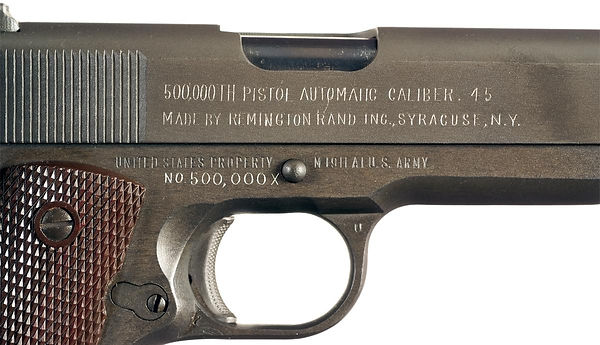
Remington Rand M1911A1 Pistol
When World War II broke out, Remington-Rand had been a typewriter company for 55 years, and they made a right decent typewriter (I owned one), but they were a long way out of the firearms business. Nevertheless, Uncle Sam needed war material and any number of manufacturers were pressed into service building things that they had never built before for the war effort. But why didn’t Uncle get Remington Arms to build the pistols? The answer is really pretty simple. The War Department needed Remington Arms to do what it did best and that was to produce ammunition. Other folks could crank out the pistols.
Remington Rand was awarded its first order on March 16th, 1942, for a total of 125,000 1911A1 pistols. The company had no experience building pistols at the time it was awarded the contract. Remington Rand formed a new division to take charge of building the pistols. The division formed was designated Remington Rand “C” Division. After winning the contract, they converted a vacant plant once used for building typewriters to the production of M1911A1 pistols. The old plant was located on Dickerson street in Syracuse, N.Y.
The first 255 production pistols where accepted by ordnance inspectors in November of 1942. In the beginning, some manufacturing equipment was still unavailable and this caused Remington Rand to acquire parts from other sources to complete the early pistols. They purchased barrels from High Standard, Colt, and Springfield Armory; disconnectors from US&S; grips safeties from Colt; and slide stops from Colt and Springfield Armory (2,865 left over from WWI).
By March of 1945 they where building the lowest price pistol in the war effort and quality was considered second to none. It is important to note that in March 1943, James Rand, Jr. stopped production due to interchangeability test failures. The guns where not meeting the government requirements for parts interchangeability and had a very high rejection rate. After a change in management, production resumed in May of 1943 with the interchangeability and rejection rate problems solved. By the end of the war Remington Rand had produced over 875,000 pistols, almost twice as many as Colt and Ithaca combined.
The most amazing part of the story is in how many of the Remington Rand pistols are still in service today, 55+ years after they were built by the typewriter company in Syracuse that knew nothing about building guns. Their owners swear by them, and if they haven’t been abused, they’re still solid and dependable pistols. I wish I had a dozen of them.



Reviews
Remington's 1911 R1 45 ACP
A lot of gun in a small box
By Joe D'Alessandro Editor | RealGuns.Com
http://www.realguns.com/articles/261.htm
Remington's production of a 1911 type pistol should not come as a surprise to anyone. The company has a talent for manufacturing high grade firearms and, in this case, Remington is building to a design that has been perfected by one hundred years of production and shooter experience. The result is a gun that should have broad market appeal.
The basics:
Manufacturer: Remington
Model: 1911 R1
Country of Origin: U.S.A
Type Action: 1911 Single Action Autoloader
Frame&Slide: Alloy Steel
Finnish: Satin Black Oxide
Grips: Checkered Walnut
Caliber: .45 ACP
Capacity 7+1
Barrel length 5”
Twost 1:16” LH
Weight 38.5 oz
Overall :enght: 8.5”
Overall Height: 5.5”
Sights: Three Dot White
Sight Adjustment: Windage
Sight Radius: 6.25”
Trigger Pull: 4lbs 13oz
MSRP: $699
Supplied: R1, Hard Case, 2 Magazines, gun lock and manual.
The Remington R1 is similar to an M1911A1 version of the popular 1911 Government Model. Differentiating it from the original M1911, the frame is clearance cut to enhanced trigger pull, a short trigger is employed and the grip safety tang is extended. Like the original M1911, the R1 has diamond patterned checkered grips and a flat mainspring housing. The Remington's hammer width, at 0.281", is slightly more narrow than the 0.309" M1911A1 wide spur piece.
The Remington 1911 R1 also incorporates popular commercial Model 1911 enhancements: flared and lowered ejection port, a Novak standard dovetail mount front sight, beveled magazine well, a match grade stainless steel barrel bushing, and a Series 80 type trigger assembly. Produced entirely at Remington's Ilion, New York plant, as shipped, the R1 can serve as a very competent gun for self defense or recreational target shooting.
As a near MIL spec gun with well-established enhancements, Remington's R1 will accept all popular 1911 type upgrade pieces, which means it will no doubt serve as the basis for many enhanced and customized guns. After working with a number of 1911 types produced outside of the U.S., personally, I am really happy to see Remington make this gun available.
The R1's sighting system...
A Novak 65° x.330" standard dovetail replaces a staked in front sight, the aft dovetail is standard GI. This means there are tons of accessory sights that will fit this gun. That said, the factory three dot system works well and the small set screws in the factory sights facilitate both drift sight adjustment and replacement.
Control and status check...
The 1911 R1 is a gun for right-handers. Magazine release, thumb safety are both actuated with the right hand thumb. Yes, ambidextrous safeties and magazine releases can be installed to suit shooter's preference. The Remington gun has a small slot in the barrel tang that serves as a loaded chamber indicator. The rim of a chambered cartridge shows in the slot.
A little more detail please...
The slide to frame fit is good; not so tight that it takes two men and a small boy to rack the slide, but not so loose that slide rattles. This is an 80 Series configuration so there is a firing pin plunger and spring, next to the firing pin stop, that locks the firing pin until the gun's trigger is fully depressed. The slide has clean machine finishing inside and out and smooth fitting piece parts. These are all standard 1911 spec parts and configurations; firing pin, springs, stop, extractor, etc. which opens the door to the use of enhanced parts and accessories, as well as parts interchangeability.
The stainless steel barrel, bushing and link assembly are close fitting parts and well finished. Lug engagement, checked with modeling clay compression was approximately 92% or a bit more. The barrel measured 0.580" at the muzzle, the bushing inside diameter for the first 0.240" measured 0.581" for 0.001" clearance. This is more than tight enough for a service pistol and about 500% less than the slop fit of the imported 1911 guns I've seen. This is critical territory when it comes to a 1911's accuracy.
The frame casting is slick; no rough spots, pits or parting lines. Machining operations performed on the frame are clean, pins are properly located, frame rails check parallel and all internal ways are flat, smooth surfaces. The quality of the casting and machine work is very similar to the work found on a high end SIG. Remington has been able to manufacturer a quality 1911 while its competitors are pushing cheapo imported "GI" models for the same price or more. For these reasons, the R1 will be incorporated into our future 1911 projects.
Bits and pieces...
The Remington 1911 R1 isn't hiding poorly made parts and cheap production. Again, really clean casting and machine work all around. The parts are much better in fit and finish than most of the drop in upgrade third party parts. No parting lines on the hammer, hammer hooks and sear ledge are cleanly formed and contact and engagement is uniform. Depth of sear engagement is carry gun worthy and appropriate, so there is room for some trigger finessing to lighten pull. There really is no creep in the factory trigger which makes it a really good 80 Series trigger.
I ran through all of the traditional parts fit checks and was not able to find any problem areas. Even the trigger bow dropped with gravity within the frame channels and there was no drag with a magazine inserted. The mainspring housing is steel, no attempts at hiding plastic parts. I accept the need for manufacturers to install firing pin blocks to assure compliance with various state laws. Fortunately, Remington was able to fit 80 Series trigger linkage without degrading function.
The only part that made me a little crazy was the thumb safety. It was installed and fit properly, but the safety lock plunger recess was a little deep... a little, crisp so the frame would not surrender the safety to disassembly without a bit of a fight. Personally, I can live with that minor struggle in exchange for a safety with positive actuation. All of the controls works properly; magazine release, grip safety, slide stop, etc. Disassembly of slide from frame did not require tools, although a bushing wrench is included in the case with the gun.
Taking a break to think about this....
I spend a good deal of time shooting 1911's converted to .45 Super or .460 Rowland, however, I don't often get the opportunity to spend time with a full size .45 ACP Model 1911. Shooting the Remington 1911 R1 with Remington 230 grain ball ammo was... relaxing. At 809 fps over the chronograph, the big slug moves with conviction, but recoil is actually quite mild. At seven to ten yards, shooting offhand, quickly, it was easy to keep three and five shot groups under an inch or inch and one half. The sights are easy to follow and align and the grip is quite comfortable. Group sizes
remained tight, the gun didn't develop a rattle and, for as tight as the gun was, the slide felt as though it were moving over ball bearings. Clean up was easy, the durable black oxide finish wiped down with a silicon cloth. The last check out for the gun was to check out reliability and accuracy with a variety of ammo types...
Sure it was fun disassembling the Remington 1911R1, for a couple of reasons. The first was the confirmation that this is a quality autoloader. The second, and perhaps of greater importance, was the thrill of taking apart a firearm and wondering if I would be able to reassemble it... without left over parts. There is actually an RG office betting pool regarding the latter. The better part however, was blasting away and finding the R1 to be a well-behaved, accurate and quite controllable firearm.
The Remington R1 manual calls out 230 grain ball for recommended ammo, which is actually pretty typical for manufacturers of 1911 type guns to stipulate. Makes sense as the gun's sights, feed and recoil management mechanisms need to be tuned for some standard and ball ammo is about as reliable in use as ammunition gets. Which of course was why I felt it would be a good idea to try a variety of loads to see what a new Remington 1911 R1 owner might expect.
Now this was a lot of fun...
My personal favorite for the .45 ACP are 185 grain loads. I believe I developed the affinity for this bullet weight when one of my favorite guns was a short barreled Officers Model and it seemed the heavier weights wouldn't expand at short barrel velocity. A five inch barrel gun brings a lot more flexibility. The bullets appearing on the table below are in descending order as they appear left to right above. Alliant Power Pistol was selected for all loads as it is an excellent pistol powder, it is slow enough to be tenth grain forgiving and it produces uniform shot to shot performance. The table illustrates the two sides to every big bore discussion; high velocity and full expansion, or heavy bullet, moderate expansion and high momentum for penetration. All loads were very manageable in live fire and all delivered better than recreational shooting accuracy from a two handed hold... which means the gun's potential for accuracy was beyond the proficiency of the shooter. There was a relatively small shift in point of impact as bullet weight varied, an inch climb when going to from 185 grain Remington JHP handloads to Remington 230 grain ball ammo. I'll attribute the little extra velocity at 185 grains for the Golden Saber to the bullet's reduced bearing surface and incorporated driving band. This is an excellent starting point for an out of the box factory gun.
Is there life after Euro-Boy guns?
I can embrace technology as much as the next guy. My wife accepts it and doesn't seem to mind. However, I am at a point where the words "poly" and "striker" begin to
read as "tired" and "bored" and I realize I don't have to accept what companies are pushing, or what people emphatically tell me I have to like in response to a trend. I am a firearm enthusiast first, so I get to like whatever it is that I like and no justification is required. Personally, guns with lots of personality hold the greatest appeal and the Remington 1911 R1 seems to have a surplus.
The R1 feels like a gun, cold metal, the heft of substantiality... and blue as should be the case with useful and well-made machinery. The Remington 1911 feels solid when the slide is racked and the hammer is left back when it is cocked and locked so there is no ambiguity of purpose. The trigger feels like a real trigger, not a sponge ball with no beginning or end to compression. The gun digested and ejected virtually every bullet shape in use without hesitation or fault. A reliability that is a must in a defensive firearm. Pull a Golden Saber slug out of ballistic medium and it expands to the size of a golf ball and hangs into all of its weight.
You'd never see the R1 carried by the characters of fictional police TV shows. A 1911 would be too politically incorrect and not at all like the Glocks that these male and female models draw quickly, but never seem to pull the trigger even when someone's life is in jeopardy. The R1 is not a gun designed for video game appearances, movie action heroes or villains... or SyFy Channel fans. The Remington 1911 R1 is a workhorse gun that would provide many years of self-defense and lots of recreational shooting With a little tweaking and refining, it would make a heck of a gun for competition. Nice gun. Great value.

The Remington R1 M1911
by Wiley Clapp - Thursday, January 13, 2011
http://www.americanrifleman.org/articles/2011/1/13/the-remington-r1-m1911/
The shooting industry and shooters everywhere are reflecting on the significance of 100 years of unbroken service for the grand old semi-automatic—the M1911 pistol—that has done so much for this nation. Understandably, many of our handgun makers have geared up to offer special editions of the .45 pistol. But the pistol we are concerned with here does not come from one of the storied plants that made handguns for the troubled times of the 20th century. This .45 comes from the leading manufacturer of long arms—Remington, the country’s oldest gun maker. The pistol is called the R1 and it is a G.I.-style M1911 .45 ACP pistol in every sense of the word.
Lest there be confusion about historical matters, let’s take a look at Remington’s one previous foray into M1911 .45 ACP pistols. In the period from 1917 to 1918, foreign influences dragged America onto the international stage and into the horrors of World War I. It was a conflict for which we were ill-prepared. This was particularly true with arms and ammunition. We had to send tens of thousands of troops to fight in the trenches of France, and they needed guns that we didn’t have; therefore, American factories went on three-shift production. Colt was the primary source of the newly adopted Model of 1911 pistol, although Springfield Armory contributed guns before it had to focus exclusively on M1903 rifles. The Army Ordnance Dept. awarded contracts to several American factories for large quantities of the popular semi-automatic pistols. In that time, Remington was known as Remington-UMC (for Union Metallic Cartridge Co.) and the pistols it made were so-marked. Approximately 21,500 U.S. Model of 1911 pistols came from Remington’s Ilion plant before the war ended and further production became unnecessary. Today, those pistols are much-sought-after collector’s items. It is important to understand that the World War II M1911A1 pistols marked “Remington-Rand” were produced by a manufacturer of office machines unaffiliated with the Remington Arms Co.
So yes, today’s Remington does have a history of making the Government Model, certainly none of the original tooling was used, and certainly none of the original technicians are still standing at their machines. Think of the gun at-hand as a new project. Some critics have already noted that Remington management missed an opportunity to precisely replicate the original M1911-style pistol. The gun we see is an M1911A1-style, and Remington is clearly looking forward and not to the past. A careful inspection shows a G.I.-looking pistol with few frills, intended to sell at what has been called an entry-level price.
This is an all-steel pistol in a dull greenish gray, non-reflective finish. It closely follows the original John Browning design for a service .45 with a tilting-barrel form of recoil operation. This brings the barrel down at its rear to clear locking lugs atop the barrel, out from their matching recesses in the roof of the slide. The gun feeds from a seven-round magazine housed in the butt section. All of the controls—thumb safety, magazine catch, trigger, slide lock and grip safety—closely approximate the size and shape of the parts used on World War II pistols. Most of those guns wore molded plastic grips, brown in color and with a functional checkered surface. The new gun has a nice pair of walnut stocks, checkered in the famous double-diamond pattern that was used on original guns inBlackjack Pershing’s time.
By now it should be obvious that the R1 reflects an effort to build a strong and sensible G.I.-style gun and not to replicate any particular model produced through the years. It has the flat mainspring housing of the M1911s, but it has no lanyard ring, as used on almost all G.I. guns. The M1911A1 combined a short trigger, a long tang grip safety and relief cuts aft of the trigger guard—so does the new Remington.
So let’s look at the R1 from the standpoint of what it is, and not what it might have been, or could have been. It is a strong, sound M1911 pistol that was made to be used—and used hard. The gun was built using today’s expeditious technology. The receiver is an investment casting, and most of the small parts are either metal injection molded (MIM) or investment cast. The magazine is marked “R 45 AUTO” and is of the G.I.-type with welded-in bottom plate. All of the markings look like they’re pantographed and are deep and crisp. They can be read much easier than the laser systems used by some other makers. Just about everyone who uses an M1911 agrees that you have to follow Jeff Cooper’s advice and install sights that are big enough to see. On this pistol, the sights are very large; and both front and rear are securely dovetailed into the slide top. And yes, they do have the popular three-dot highlights.
There is no evidence that either of the two specimens I had for evaluation was hand-fitted or -finished. They had rather heavy trigger pulls (about 5 pounds), and both exhibited creep and a little overtravel. I have to remind myself that I am an inveterate user of M1911 pistols, and I am accustomed to pistols tuned by custom pistol smiths. So the multiple sharp edges and corners that such ’smiths remove were present on the Remington R1s I evaluated. I could get used to them, as well as the less-than-ideal trigger pull.
As is the custom with for American Rifleman, I accuracy tested the R1 by shooting five consecutive, five-shot groups at 25 yards. I did this with three different loads, each of which I have used many times with other .45 pistols and have proven exceptionally accurate. Before any accuracy work, I did run about 10 magazines of mixed ammunition through the gun to break it in. Then it was on to the Ransom Rest, in this case C-clamped to a solid concrete bench. In order, I shot Federal 230-grain Gold Medal ball, Black Hills 230-grain JHP and Remington 230-grain Bonded Golden Saber JHP.
The evaluation produced 15 five-shot groups ranging in size from a smallest of 1.24 inches to a largest of 2.99 inches. The three test loads averaged 2.06 inches, 2.16 inches and 1.85 inches, respectively, with an overall group average of 2.02 inches.
These results are tabulated above and pretty well establish that the Remington R1 is pretty much a 2-inch shooter at 25 yards. As further indication of that standard, consider what happened when I went digging around in the .50-cal. ammo can that houses my supply of .45 ACP for the range. There were several partial boxes of ammunition of various kinds, none of which amounted to enough to repeat the five-group protocol. I decided to shoot some 10-shot groups with the leftovers, just to see what the R1 could do with them. Ten Speer Lawman 200-grain TMJ bullets went into 3.13 inches, and Hornady’s 200-grain JTC produced a 2.87-inch group. But the Remington really liked Federal’s other Match load, the 185-grain SWC, shooting 10-shot groups measuring 2.01 inches and 1.85 inches, respectively. The real delight was the group fired with long out-of-manufacture Pro Load 200-grain JSP. It measured 1.45 inches. To put its accuracy in context, I have evaluated guns that shot a little better than this, and you may have read some of my reports. But seldom does a gun come along that shoots this well and costs anywhere close to the $699 for which the R1 retails.
It’s certain that Remington put a pretty good barrel in the pistol, but a couple of other things that aren’t so obvious need to be highlighted. A good barrel is important to accuracy in an M1911 pistol, but the consistency of the lock-up between the barrel and the slide is at least equally important. Remington has kept the tolerances tight and established a systematic fitting procedure to achieve consistent lock-up.
Another matter to consider is the ammunition. Although we still import quantities of plinking ammunition, our native ammunition industry is the best in the world. Annually our cartridge makers turn out millions of rounds of high-quality ammunition, because that is what American sportsmen want. The Remington R1 is a good gun when shooting good ammunition. Together, they both perform.
There is no handgun so thoroughly customized as the M1911 .45 ACP. Yankee pistoleros derive endless delight in fiddling with the innards—and “out-ards” —of their guns, and I’m certain that more than a few R1s will be subjected to this treatment. Based on what I have seen in the early samples, the R1, while perhaps a bit rough in some aspects, is nonetheless generally solid and reliable. Its accuracy is much better than what you would expect for an entry-level pistol, and at $699 it strikes me as a very good buy.





© 2015 by remington1911r1@gmx.net Proudly created with Wix.com